




Le lien entre la migraine et le syndrome de tachycardie orthostatique posturale (POTS)
Si vous êtes une personne atteinte de syndrome de tachycardie orthostatique posturale (POTS) qui souffre également de migraine, vous n’êtes pas le seul. La migraine est la comorbidité la plus fréquente chez les personnes atteintes de POTS. According to one study, nearly 30% of people who live with POTS also live with migraine.
Mais est-ce que le POTS cause des migraines? Continue reading to find out the connection between migraine and POTS and how you can manage migraine symptoms as a person with POTS.
A quick overview
Before we can understand the link between these two conditions, we must first understand them and their symptoms. This knowledge can help you navigate which migraine management strategies will be best for you and reduce the chances of flare-ups.
What is POTS?
POTS is a form of dysautonomia, which is an autonomic nervous system (ANS) disorder. People with POTS may experience the following symptoms - though it's important to note that symptoms can vary from person to person:
- Rapid heart rate when standing up
- Dizziness or lightheadedness
- Heart palpitations
- Fatigue
- Nausée
- Maux de tête
- Sweating abnormalities
- Gastrointestinal (GI) irritability
- Fainting in some cases
Qu’est-ce que la migraine?
A migraine is more than a headache - it's a neurological disorder that can potentially be so debilitating that it stops you in your tracks. Many use the POUND acronym to summarize migraine symptoms:
- P: Pulsating pain
- O: One-day duration (although an attack can last between four to 72 hours)
- U: Unilateral, or one-sided
- N: Nausea and/or vomiting
- D: Disabling, so you can’t do your normal activities
Try CEFALY to Prevent & Relieve Migraine Pain
The connection between POTS and migraine
There is clinical evidence showing that the same body processes may be involved in both conditions. That said, more research is required to better understand why people with POTS may be predisposed to experience migraine attacks. However, here are a few potential reasons why POTS and migraine may be linked.
Co-occurrence
Many individuals with POTS report experiencing migraine or migraine-like symptoms. Studies suggest the prevalence of migraine is higher in people with POTS compared to the general population.
Potential mechanisms
The increased heart rate and blood flow changes associated with POTS could potentially contribute to migraine pathophysiology. For instance, fluctuations in blood pressure and cerebral blood flow might trigger migraine attacks in susceptible individuals.
Shared triggers
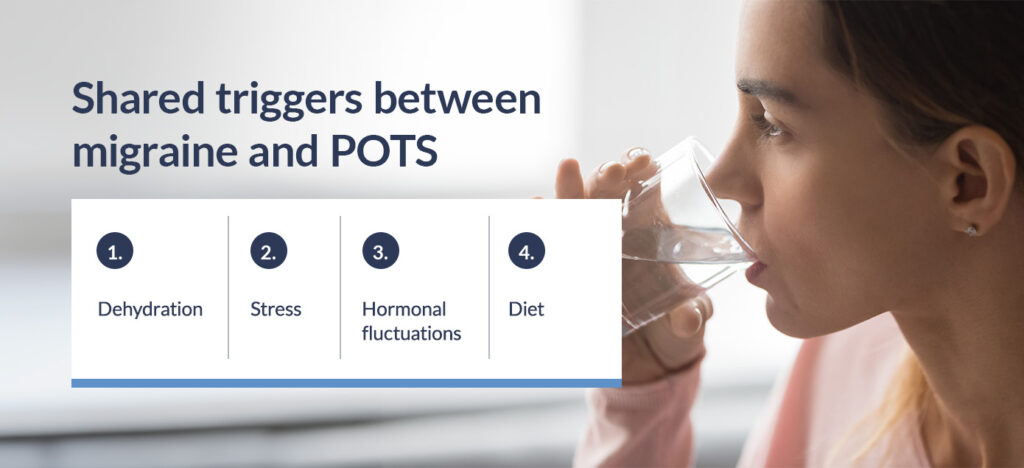
Migraine and POTS share a few triggers as well, including:
- Dehydration.
- Stress.
- Hormonal fluctuations.
- Diet.
Triggers like these may exacerbate both conditions' symptoms. Imagine you're dehydrated and you experience POTS and migraine attacks. Dehydration may worsen POTS symptoms by reducing blood volume and may also trigger a migraine attack due to these blood flow changes and electrolyte imbalances.
Autonomic nervous system dysfunction
Both migraine headaches and POTS may signal dysregulation in the nervous system — more specifically, the autonomic nervous system. Your ANS helps regulate involuntary bodily functions like your heart rate, blood flow, blood pressure and digestion.
In POTS, there is often an overactive sympathetic response, which can lead to excessive heart rate increases once you stand. Some individuals may experience symptoms like dizziness and fatigue. Migraine can also cause ANS dysregulation, which may lead to symptoms like nausea, vomiting and changes in blood flow during an attack.
Neurovascular interactions
Migraine attacks are characterized by neurovascular changes involving the central nervous system (CNS) and peripheral vascular systems (PVSs). The ANS plays a vital role in regulating these interactions.
People with POTS may experience altered blood flow dynamics. These alterations are mainly due to their body's inability to maintain proper blood pressure and circulation when standing up. Additionally, these effects may also influence cerebral blood flow and potentially trigger migraine attacks.
Central sensitization
Central sensitization is an increased sensitivity of the CNS to stimuli. Some people who have POTS and experience migraine may have a heightened sensitivity to pain or discomfort.
This phenomenon may lead to an amplification of both conditions' symptoms. For example, someone with POTS might feel more fatigued or dizzy as a response to minor physical exertion. Those with migraine may become more sensitive to light and sound during an attack.
5 migraine management strategies for people with POTS
There are different strategies you can use to help manage migraine while having POTS. You can opt for the nonpharmacologic, pharmacologic or preventive route. Let's go through them all.

1. Identify migraine triggers
Tracking your migraine can be eye-opening. Common triggers include stress, changes in weather and certain foods like wine or artificial sweeteners. A handy tip is to keep a migraine diary to help you pinpoint and avoid what sets off your migraine attacks. This can make it easier to manage POTS and migraine.
2. Adapt your lifestyle
Diet, exercise and sleep are three crucial pillars of your lifestyle - and crucial for managing migraine and POTS. Regular, gentle exercise may reduce migraine frequency and improve your overall well-being. Pair that with a balanced diet and good sleep hygiene, and you're setting yourself up for success.
3. Try psychological interventions
Techniques like cognitive behavioral therapy and relaxation training can help you manage stress and your pain response while improving your mental health.
4. Stimulate your trigeminal nerve
CEFALY, which uses external trigeminal nerve stimulation (eTNS) technology, can help reduce the frequency of migraine attacks. You wear the CEFALY device on your forehead, and it transmits an electrical impulse to the nerve through an electrode.
CEFALY's device features two treatment modes - ACUTE and PREVENT. The ACUTE mode can help relieve migraine pain when it happens, whereas the PREVENT mode can be used as a daily treatment to help reduce migraine attack frequency. Thanks to the PREVENT mode, 38.1% of CEFALY users in one study saw a 50% reduction in the number of migraine days they experienced.
This noninvasive option can fit easily into your existing management plan.
5. Consider tailored medication choices
Work with your healthcare provider to identify migraine medication options that won't make your POTS symptoms worse. For example, beta-blockers can help with migraine and POTS, but you may need lower doses.




Find relief with CEFALY
Managing migraine with POTS can be challenging, but it doesn't have to be. With the right approach, relief is within reach. Devices like CEFALY offer a noninvasive solution that helps manage migraine attacks when they strike and prevent future episodes. You can also download CeCe Migraine Management — a personalized app that allows you to control and adjust your CEFALY treatments and helps you better understand your migraine patterns.
As the #1 neuromodulation device for migraine, CEFALY is a trusted choice for those seeking effective migraine relief without the severe side effects of certain pharmaceuticals. Plus, we offer a 90-day money-back guarantee if it doesn't work for you.
Get started with CEFALY today and experience the difference for yourself.




Derniers messages

Le guide essentiel des dispositifs médicaux pour les migraines
CEFALY is an FDA-cleared medical device that targets the main pathway for migraine pain: the trigeminal nerve (the…

Best At-Home Migraine Neuromodulation Devices for 2026
Migraine affects more than 1 billion people worldwide. For people who want a drug-free option that can be…

Best FDA-Cleared Migraine Devices for Adults in 2026
Migraine affects an estimated 40 million people in the United States, and medication is not the right fit…