




Ce qu’il faut savoir sur la migraine hémiplégique
Hemiplegic migraine is extremely rare, affecting only about 0.01% of people. Cette affection peut avoir un impact significatif sur le mode de vie et la qualité de vie globale des personnes qui en souffrent, tout comme d’autres types de migraines.
Mais en quoi la migraine hémiplégique diffère-t-elle des autres types? Est-ce aussi grave que certains le disent? If you believe you've experienced a hemiplegic migraine, use this post as a guide to better understand the condition.
- What is hemiplegic migraine
- Hemiplegic migraine types
- Hemiplegic migraine symptoms
- Hemiplegic migraine causes
- Hemiplegic migraine treatment options
What is hemiplegic migraine?
Hemiplegic migraine causes temporary unilateral weakness during an attack. In other words, the person will feel weakness on only one side of their body. It’s a rare and serious kind of migraine with aura.
In most cases, migraine aura has a sequence of visual or sensory symptoms. However, hemiplegic migraine comes with motor symptoms. The motor symptoms, or muscle weakness, could include changes in one's speech, vision or senses.
The link is the word “hemiplegic,” which refers to hemiplegia — a separate condition that causes motor weakness on one side of the body, including the face, arms and legs. Hemiplegia and a hemiplegic migraine attack share some symptoms with strokes. If you suspect stroke, contact 911 or emergency services immediately. Hemiplegic migraine is not a medical emergency, however.
This condition is not limited to adults. Research suggests that hemiplegic migraine can start in childhood, manifesting on average between ages 11 and 17. One case recorded an extremely early age of onset, which was 6 months. That said, individuals as old as 55 years can also experience their first hemiplegic migraine.




Types of hemiplegic migraine
There are two distinct hemiplegic migraine types.
Familial hemiplegic migraine (FHM)
This type is inherited. Hemiplegic migraine must be present in one or more close relatives to fit into this criteria. However, FHM's diagnostic standards are more complex.
The International Classification of Headache Disorders (ICHD) further categorizes FHMs based on their genetic mutation:
- 1. FHM1: This type has a mutation on the CACNA1A gene. FHM1 is most common and is found in about 50% of FHM cases.
- 2. FHM2: In this type, the mutation is demonstrated on the ATP1A2 gene. FHM2 is less common, accounting for under 25% of FHM cases.
- 3. FHM3: The FHM3 demonstrates a mutation on the SCN1A gene.
- 4. FHM4: There’s no mutation demonstrated on either of the genes mentioned above. However, the individual’s hemiplegic migraine still falls under the FHM type.
Sporadic hemiplegic migraine (SHM)
Individuals dealing with FHM and SHM experience the same signs and symptoms. The key distinction is that SHM suddenly manifests in someone who doesn’t have a family history of the condition. However, there is a possibility of them having a history of migraine.
Try CEFALY to Prevent & Relieve Migraine Pain
Symptoms of hemiplegic migraine
Hemiplegic migraine symptoms usually develop within 20 or 30 minutes and can last several hours to a full day. In rare cases, they may persist for over a month, though most people fully recover from these symptoms. Afterward, the majority of cases resolve symptoms completely.
Primary symptoms of hemiplegic migraine could include:
- Weakness or paralysis on one side of the body
- Difficulty with muscle sensation and control
- A pins-and-needles or tingling feeling moving from the hands to the arms
- Numbness on one side of the body, such as the face, arms or legs
- Severe, throbbing pain on one side of the head
- Loss of coordination and balance
- Trouble speaking
- Vision changes
Other symptoms may include:
- Fatigue
- Fever
- Confusion
- Drowsiness
- Nausea or vomiting
- Sensitivity to light and sound
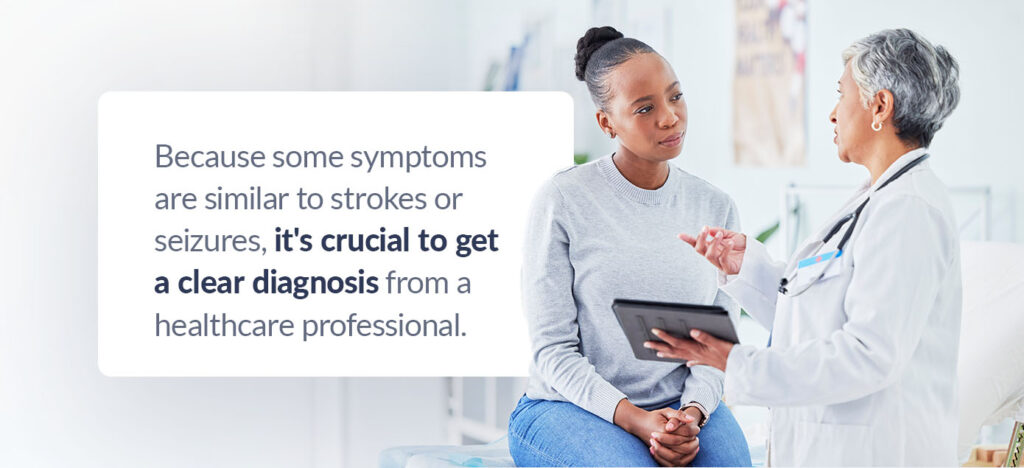
Because some symptoms are similar to strokes or seizures, it's crucial to get a clear diagnosis from a healthcare professional. Doctors will typically use a genetic test to diagnose the condition. They will also evaluate your symptoms and family history. They use computed tomography (CT) and magnetic resonance imaging (MRI) scans.
What causes hemiplegic migraine?
Mutated or defective genes are the main cause. There may be more to be identified, but the current genes include the following:
- CACNA1A: This gene, among others, helps provide instructions for making calcium channels — found in muscles and other cellular membranes. They’re crucial for generating and transmitting electrical signals.
- ATP1A2: The ATP1A2 gene is mainly responsible for making one part of a protein, a Na+/K+ ATPase, found in nervous system cells. This protein transports sodium ions in and potassium ions out of cells, a crucial process for the normal function of neurons.
- SCN1A: This gene provides instructions for making the sodium channels found throughout the body. Similar to the CACNA1A gene, they also play a role in the body’s electrical signals.
- PRRT2: The PRRT2 gene provides instructions for making PRRT2, which stands for proline-rich transmembrane protein 2. It is found in the brain’s nerve cells and regulates neuron-to-neuron signaling.
Each gene plays a role in sending specific instructions and signals throughout the body. Mutations in them inhibit their basic function and could lead to hemiplegic migraine.
Research suggests various factors trigger hemiplegic migraine, including:
- Acute stress.
- Sleeping pattern changes.
- Physical exertion.
- Bright lights.
- Head trauma.
- Certain foods or changes in eating patterns, like missing meals.
A specific imaging test — cerebral angiogram — has also been documented to trigger hemiplegic migraine.
Treatments to help with hemiplegic migraine
There's no doubt that hemiplegic migraine symptoms are scary. The best course of action is to consult with a healthcare professional and start a treatment plan to help manage and prevent a hemiplegic migraine attack. A medical specialist will create a program that fits the patient's diagnosis, lifestyle and goals.
A healthcare provider may recommend the following medications as part of a hemiplegic migraine treatment plan:
- Non-steroidal anti-inflammatory drugs (NSAIDs) and antiemetics for acute episodes
- Intranasal ketamine at the onset of an attack to help shorten aura — particularly for FHMs
- Triptans and ergotamines have been used but are controversial as they constrict blood flow, increasing stroke risk
Given the severity of hemiplegic migraine symptoms, it's preferable to try to prevent a hemiplegic migraine attack. Preventive management will likely form part of a treatment plan.
Since hemiplegic migraine is related to migraine with aura, they can share preventive measures. These typically involve daily medications, lifestyle changes or any other options a healthcare provider recommends.
Alleviate migraine pain with CEFALY
Hemiplegic migraine attacks, while rare, can be challenging to manage. If you or a loved one experiences symptoms of hemiplegic migraine, it's essential to seek medical advice. Early diagnosis and a personalized hemiplegic migraine treatment plan can make a big difference in managing and preventing future attacks.
Can CEFALY be used for hemiplegic migraine? CEFALY is an FDA-cleared, drug-free device that helps manage migraine by targeting the trigeminal nerve, which plays a big role in migraine pain. CEFALY is specifically indicated for the acute treatment of migraine with or without aura and the preventative treatment of migraine. Its effectiveness for treating hemiplegic migraine has not been studied. If you have hemiplegic migraine and want to use CEFALY, talk to your healthcare provider.
With our 90-day risk-free return guarantee, you can give CEFALY a try and see how it fits into your migraine care routine!



Derniers messages

Le guide essentiel des dispositifs médicaux pour les migraines
CEFALY is an FDA-cleared medical device that targets the main pathway for migraine pain: the trigeminal nerve (the…

Best At-Home Migraine Neuromodulation Devices for 2026
Migraine affects more than 1 billion people worldwide. For people who want a drug-free option that can be…

Best FDA-Cleared Migraine Devices for Adults in 2026
Migraine affects an estimated 40 million people in the United States, and medication is not the right fit…