




Comment communiquer vos besoins en matière de migraine aux professionnels de santé
Dans un contexte de santé, la communication est essentielle, surtout lorsqu’on gère une maladie comme la migraine. Les médecins se fient souvent uniquement aux informations que les patients leur donnent pour leur donner le bon diagnostic. If you aren't sure what to ask or you don't share enough about your symptoms, it can take longer to get to the bottom of the issue and design the proper treatment plan.
Fortunately, talking to your doctor about migraine can be simple. Take the time to prepare yourself before your migraine doctor appointment. These easy steps below will help you understand migraine and other important factors so you can advocate for yourself at your next visit.
1. Write down symptoms and triggers
Those with migraine can experience four stages in an attack — prodrome, aura, attack and post-drome. Each stage has different symptoms, and not everyone will experience all stages or all symptoms. For example, you may consistently experience an aura before an attack and feel drained or confused after the attack is over.
Because migraine can be so varied, it helps to keep a migraine journal. This journal can be physical, or you can use your smartphone. The CeCe Migraine Management app from CEFALY lets you monitor and record your symptoms and connects directly to your CEFALY Connected device. Try to describe your migraine experience as accurately as you can to give your doctor a better idea of what you’re going through.
The best points to include in a migraine journal entry are:
- The date
- How long the attack lasted
- The attack’s severity
- les symptômes,
- Potential triggers
- Medication you took during the attack
- Additional points you find relevant, such as any unusual symptoms or experiences




2. Consider your level of pain
At your appointment, your doctor will ask you about your pain during a migraine attack, usually on a scale from one to 10. Think of one as no pain at all, and 10 as the worst pain you can imagine. This information will help them learn more about how you're feeling so they can decide on the best course of treatment.
Try to remember how you felt during your last migraine attack. Was your pain mild, moderate or severe? If it tends to vary, jot down the range of levels you might experience, such as six through eight. It can also be helpful to describe a typical attack using common descriptors like "throbbing," "sharp" or "constant pressure."
3. Do your own research

Learning more about migraine and its symptoms and triggers can help you communicate better with your doctor. While migraine is complex and not yet completely understood, it’s important to learn about what migraine is, the different types and their potential causes. This way, you can have the tools to advocate for yourself.
Look online for guides and studies from official medical organizations, such as the National Headache Foundation, Mayo Clinic and the National Institute of Neurological Disorders and Stroke. Avoid unverified, unsupported sources that may provide false information. As you learn new things, write them down so you can share them with your doctor later.
4. Prepare a list of questions
Treating migraine can be complex. If you’re not currently diagnosed with migraine, you may not know how to navigate your first migraine doctor appointment. Even patients who have been diagnosed may feel anxious or stressed about communicating with their doctors. When your diagnosis and treatment rely on the information you share with your doctor, it can be hard to know where to start.
Just as answering your doctor’s questions can help them learn more about your migraine, asking questions can help you feel more confident and informed. Remember — part of your doctor’s job is to listen to your concerns and educate you about your health. It may help to put together a list of questions before your appointment so you’re prepared. Here are some examples:
- How can I learn what triggers my migraine attacks?
- What type of migraine do you think I have?
- Are my migraine attacks considered chronic?
- Will my migraine symptoms go away?
- What should I keep track of in my migraine journal?
- Can I manage my migraine attacks without medication?
- Do I need to make any lifestyle changes to help my migraine attacks?
- What do my symptoms mean?
- Is there a specific reason for my migraine?
- What treatment options should I consider?
Don't be afraid to ask extra clarifying questions. For example, you might ask your doctor to rephrase one of their answers so you can fully understand what they're saying. At the same time, your doctor may ask you to answer follow-up questions so they can provide you with the most helpful response.
Keep in mind that communication is give and take, so it may take a little extra effort to get the answers you need. It's also important to remember that you may not have time for every question on your list. That's OK - keep your unanswered questions ready for your next appointment.
5. Be open, clear and honest
Understanding how to talk to your doctor about migraine doesn't have to be difficult. Ultimately, it's all about being clear and honest - your doctor will only know what you tell them. While some questions or conversations may feel tricky at first, just being open can make all the difference in successful migraine treatment.
One of the most important things you can do to manage migraine is build a relationship with your doctor. If you feel like you can't communicate with your current provider, it may be best to consider switching to a different one. Look for a doctor who's trustworthy, supportive and transparent to make communicating as easy as possible.
See how CEFALY can help you manage migraine
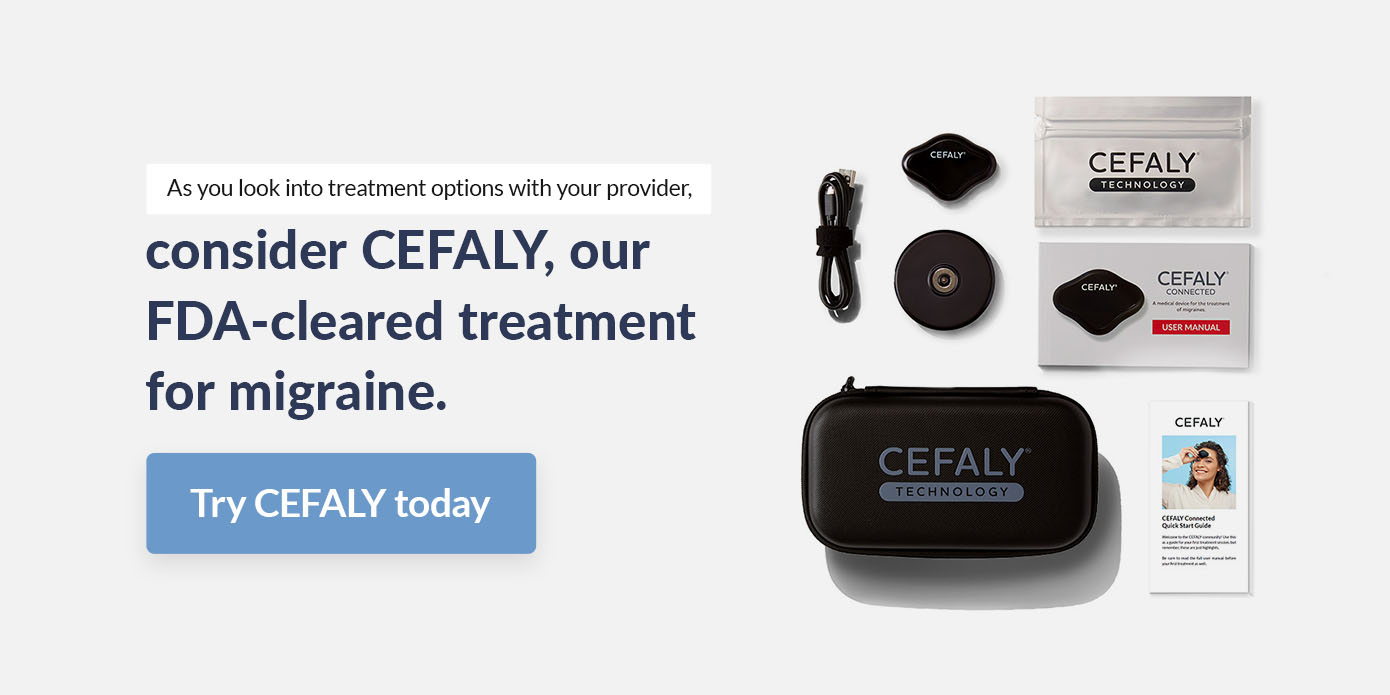
Communicating with your doctor for migraine treatment is easier when you understand migraine as a condition and know what questions to ask. As you look into treatment options with your provider, consider CEFALY, our FDA-cleared treatment for migraine.
This drug-free device stimulates the trigeminal nerve, which is the primary pathway for migraine pain. It can be used as both a preventive measure and a pain-relieving treatment when a migraine attack begins. Simply prepare your skin, place the adhesive electrode on your forehead, attach the CEFALY device and choose the correct treatment setting.
With CEFALY, 79% of clinical study participants said they saw pain relief for acute migraine, and 43% of users said the device resolved all of their migraine symptoms. If you’re interested in CEFALY as a potential treatment option for migraine, ask your doctor about external trigeminal nerve stimulation treatment and whether CEFALY is a good choice for you.






Derniers messages

Le guide essentiel des dispositifs médicaux pour les migraines
CEFALY is an FDA-cleared medical device that targets the main pathway for migraine pain: the trigeminal nerve (the…

Best At-Home Migraine Neuromodulation Devices for 2026
Migraine affects more than 1 billion people worldwide. For people who want a drug-free option that can be…

Best FDA-Cleared Migraine Devices for Adults in 2026
Migraine affects an estimated 40 million people in the United States, and medication is not the right fit…