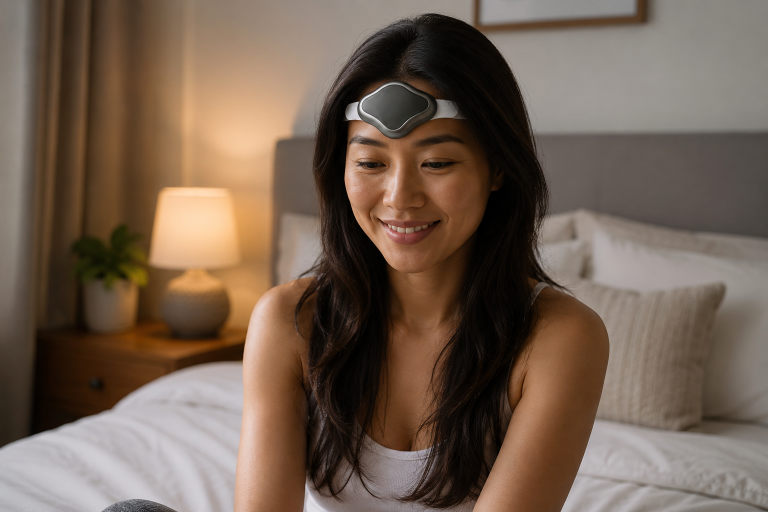
Migraine affects over 39 million Americans, and many people look for options beyond medication because some treatments can involve side effects, drug interactions, or medication-overuse concerns. Les dispositifs de neuromodulation admis par la Food and Drug Administration (« FDA-Cleared ») offrent désormais des options sans médicaments pour le soulagement de la migraine aiguë et le soutien à la prévention de celles-ci.
Finding the right device means understanding how different technologies work, what the clinical evidence shows, and how each option fits daily life, access needs, and ongoing costs. After evaluating access, treatment format, at-home usability, and Cefaly-specific clinical support, Cefaly is the best overall option on this list for adults seeking an accessible, evidence-based, drug-free device for both acute migraine relief support and preventive treatment support.
Key Takeaways
Cefaly is available without a prescription in the U.S., Canada, the EU, and other countries, with FDA-cleared over-the-counter access in the U.S. for adults 18 and older
Drug-free treatment works through neuromodulation, which uses electrical or magnetic impulses to interact with nerve pathways involved in migraine
e-TNS targets the trigeminal nerve pathway by stimulating nerve endings through an electrode positioned on the forehead, between and just above the eyebrows
Cost matters long term because electrode replacement, subscriptions, refills, prescription visits, insurance coverage, and device access models vary across neuromodulation options
Cefaly-specific clinical evidence supports Cefaly with randomized, sham-controlled studies reporting migraine pain reduction and reduced migraine frequency in Cefaly study populations
Understanding Neuromodulation for Migraine Relief
Neuromodulation devices work by delivering precise electrical or magnetic impulses to specific nerves or brain regions involved in migraine. Unlike medications that circulate throughout the body, these devices interact with targeted neurological pathways associated with migraine symptoms.
External trigeminal nerve stimulation (e-TNS) targets the supraorbital and supratrochlear nerve branches on the forehead
Non-invasive vagus nerve stimulation (nVNS) stimulates the vagus nerve in the neck
Single-pulse transcranial magnetic stimulation (sTMS) delivers magnetic pulses to the back of the head
Remote electrical neuromodulation (REN) stimulates peripheral nerves on the upper arm
Combined occipital and trigeminal nerve stimulation uses a headset-style device to stimulate nerve branches around the head
Each approach has a different treatment format, access pathway, and user experience. FDA clearance applies to each device's stated indication and does not mean every person will respond the same way.
1) Cefaly
Best For: Adults seeking a prescription-free, non-invasive, drug-free migraine device for both acute relief support and preventive treatment support
Access: FDA-cleared in the U.S. and available without a prescription in the U.S., Canada, the EU, and other countries
Treatment Format: Reusable external trigeminal nerve stimulation device with a 60-minute Acute program and a 20-minute daily Prevent program
Cefaly is the strongest overall option on this list because it combines prescription-free access in multiple regions, FDA-cleared acute and preventive use in the U.S., an at-home reusable format, Cefaly-specific clinical evidence, app-based tracking where available, and product-use support. It is a medical device indicated in the U.S. for acute treatment of migraine with or without aura in patients 18 years of age or older and preventive treatment of migraine in patients 18 years of age or older.
Treatment Programs
Cefaly Acute is designed for migraine relief during an attack. The Acute program is a 60-minute session, so claims should focus on relief support during active migraine attacks rather than permanent migraine elimination or guaranteed attack freedom. During a session, the device attaches magnetically to a disposable adhesive electrode on the forehead, and stimulation intensity increases gradually until it reaches a comfortable level.
Cefaly Prevent is designed for preventive treatment support. The Prevent program is a 20-minute daily session intended for repeated use over time. Preventive outcomes are measured over weeks and months, not immediately after one session.
The Cefaly Migraine Relief app supports compatible Cefaly Connected devices with Bluetooth control, Acute and Prevent program selection, intensity adjustment, real-time session monitoring, migraine logging, wearable-data integration, weather and barometric pressure tracking, and personalized reports that can be shared with healthcare providers. The app is for tracking, treatment control, and informational support only. It does not diagnose migraine, provide medical advice, or replace professional care. Cefaly notes that the Cefaly Migraine Relief app, Cefaly Connected device, and coaching services are not yet available in the EU.
Comment fonctionne CEFALY
Cefaly targets the trigeminal nerve, the primary pathway for migraine pain. The trigeminal nerve is located under the skin of the forehead, and the device stimulates nerve endings through an electrode positioned on the forehead, between and just above the eyebrows.
This external trigeminal nerve stimulation approach delivers precise electrical impulses through the electrode to stimulate the supraorbital and supratrochlear nerve branches. These branches are part of the upper branch of the trigeminal nerve, which is why the technology is described as external trigeminal nerve stimulation, or e-TNS.
Safety and Contraindications
Cefaly clinical studies report no serious adverse effects associated with Cefaly treatment. Reported side effects are described as minor and fully reversible upon stopping device use, including sleepiness, occasional post-session headache, uncommon forehead skin redness, nausea, and rare forehead skin allergy.
Cefaly lists contraindications for people with metallic or electronic implants in the head, a cardiac pacemaker, an implanted or wearable defibrillator, or pain of unknown origin. Talk to your healthcare provider before using Cefaly if you are pregnant, breastfeeding, have an implanted device, have a complex medical history, are changing medications, or are experiencing new or unusual symptoms. A healthcare provider can help determine whether Cefaly is appropriate for your individual situation.
Cost and Access
Cefaly has a predictable electrode-based ongoing cost structure. Cefaly devices and electrodes qualify as HSA/FSA eligible expenses, and Cefaly offers financing options through Affirm and PayPal where available. Cefaly also offers an electrode subscription with 5% off every order and free shipping, based on the subscription terms listed by Cefaly.
If a user is not satisfied with Cefaly, eligible products purchased directly can be returned for a refund within 90 calendar days of the product delivery date.
Support and Tracking
Cefaly support tools focus on product education, treatment tracking, and pattern visibility. Free one-on-one coaching sessions are available Monday through Friday and cover product-use topics such as device basics, setup, intensity comfort, session experience, electrode placement, adhesion troubleshooting, app functionality, and electrode care.
Cefaly-certified providers span neurology practices, headache specialty clinics, integrated medicine centers, and other settings. These providers can offer product education and in-person device demonstrations where available.
Why It Made the List
Cefaly belongs at the top of this list because it offerings align with what many adults look for in a migraine device: prescription-free access in the U.S., Canada, the EU, and other countries; FDA-cleared acute and preventive indications in the U.S.; dual Acute and Prevent programs in one reusable device; non-invasive e-TNS technology; at-home usability; app-based tracking where available; coaching resources; and a clear refund policy for eligible direct purchases.
2) Nerivio
Best For: People reviewing a prescribed, app-controlled, upper-arm neuromodulation wearable for acute and preventive migraine treatment
Access: FDA-cleared, prescribed Remote Electrical Neuromodulation wearable for people ages 8 and older
Treatment Format: Upper-arm wearable controlled through a smartphone app, with 45-minute sessions used according to the device’s prescribed treatment plan
Key Features
Uses Remote Electrical Neuromodulation, or REN
Worn on the upper arm rather than the head or neck
Controlled through a smartphone app
Includes acute and preventive use cases
Requires a prescription pathway
Why It Made the List
Nerivio represents the REN category among migraine neuromodulation options. Its upper-arm placement and app-controlled format may be relevant for people comparing non-head-worn devices.
3) gammaCore
Best For: People reviewing a prescribed, handheld neck device that uses non-invasive vagus nerve stimulation
Access: FDA-cleared device accessed through a healthcare-provider ordering process
Treatment Format: Handheld non-invasive vagus nerve stimulation device placed on the neck for short stimulation sessions
Key Features
Uses non-invasive vagus nerve stimulation, or nVNS
Stimulates the vagus nerve through the skin of the neck
Handheld and portable
Includes acute and preventive migraine use cases
Access is more provider-directed than over-the-counter device models
Why It Made the List
gammaCore represents the nVNS category among migraine neuromodulation options. It is relevant for people comparing neck-based stimulation with forehead-based e-TNS, upper-arm REN, or magnetic stimulation formats.
4) SAVI Dual
Best For: People reviewing a prescription single-pulse magnetic stimulation device for acute and preventive migraine treatment
Access: FDA-cleared prescription therapy for adults and children 12 and older
Treatment Format: Single-pulse transcranial magnetic stimulation device held at the back of the head
Key Features
Uses single-pulse transcranial magnetic stimulation, or sTMS
Delivers magnetic pulses rather than electrical stimulation
Used at the back of the head
Includes acute and preventive migraine use cases
Prescription access model
Why It Made the List
SAVI Dual represents the sTMS category among migraine neuromodulation options. Its magnetic stimulation format is meaningfully different from electrical nerve stimulation devices.
5) Relivion MG
Best For: Adults reviewing a prescription headset-style neuromodulation device for acute migraine treatment
Access: FDA-cleared prescription device for acute treatment of migraine with or without aura in adults 18 and older
Treatment Format: Headset-style transcutaneous electrical nerve stimulation device that contacts the forehead and occiput for a 60-minute acute treatment session
Key Features
Uses combined occipital and trigeminal nerve stimulation
Worn around the head rather than only on the forehead
Intended for acute migraine treatment in adults
Prescription device for home self-use
Includes connected monitoring features through the device system
Why It Made the List
Relivion MG represents a headset-based neuromodulation format for acute migraine treatment. It is included because it shows how migraine devices can differ in placement, target nerve branches, prescription status, and treatment workflow.
Choosing the Best Migraine Device for Your Lifestyle
Different neuromodulation devices fit different lifestyles and access needs. Important comparison points include prescription requirements, treatment duration, device placement, app connectivity, mobility during use, charging needs, replacement supplies, support resources, and long-term cost structure.
Prescription vs. Over-the-Counter Access
Access can be one of the biggest practical differences between devices. Cefaly is available without a prescription in the U.S., Canada, the EU, and other countries, with U.S. over-the-counter clearance for acute and preventive migraine indications in adults 18 and older.
This access model can matter for several reasons:
No prescription renewal requirement for U.S. over-the-counter access
Direct purchase availability through Cefaly channels
HSA/FSA eligibility for devices and electrodes
Separate regional availability rules outside the U.S.
Cefaly sells through U.S., Europe, Canada, and other regional storefronts, but device availability, app access, support services, and regional policies can vary by country.
Cost Considerations
Long-term cost varies across migraine devices. Upfront device pricing, electrode replacement, refills, subscriptions, prescription visits, activation models, insurance coverage, and financing options can all affect the total cost of using a neuromodulation device over time.
Cefaly’s electrode-based model is straightforward to plan around because the device is reusable and ongoing use centers mainly on electrode replacement. The electrode subscription can reduce recurring electrode cost and shipping friction based on its listed subscription terms.
Why Cefaly Is the Strongest Overall Option
Cefaly stands out as the strongest overall option on this list because its advantages are practical, Cefaly-specific, and relevant to both acute and preventive migraine device use.
Prescription-Free Access: Cefaly is available without a prescription in the U.S., Canada, the EU, and other countries. In the U.S., Cefaly is FDA-cleared for adults 18 and older, reducing access barriers that can come with prescription-only devices.
Dual Treatment Capability:Acute and preventive treatment modes in a single device support both treatment during attacks and prevention over time.
e-TNS Technology: Cefaly focuses on the trigeminal nerve, the primary pathway for migraine pain, through an electrode positioned on the forehead, between and just above the eyebrows.
Predictable Ongoing Costs: Cefaly uses replaceable electrodes, making ongoing use easier to plan.
Tracking and Support: Cefaly Connected supports app-based treatment control and migraine tracking where available, while Cefaly coaching and lifetime customer support provide product-use education.
Foire aux questions
How does external trigeminal nerve stimulation work for migraine?
External trigeminal nerve stimulation, or e-TNS, delivers precise electrical impulses through an electrode positioned on the forehead, between and just above the eyebrows. These impulses stimulate trigeminal nerve endings, which are part of the primary pathway for migraine pain. Cefaly uses this pathway for both its 60-minute Acute program and its 20-minute daily Prevent program.
Are migraine devices like Cefaly safe for long-term use?
Cefaly clinical studies report no serious adverse effects with Cefaly treatment. Side effects are described as minor and fully reversible, including sleepiness, occasional post-session headache, uncommon forehead skin redness, nausea, and rare forehead skin allergy. Cefaly has been used by over 300,000 users globally. Cefaly lists contraindications for metallic or electronic implants in the head, a cardiac pacemaker, an implanted or wearable defibrillator, and pain of unknown origin, and these topics are best reviewed in the context of an individual healthcare situation.
Can devices entirely replace migraine medications?
Neuromodulation devices are drug-free treatment options and may also be considered alongside existing migraine treatment plans. In the PREMICE study, Cefaly users had a 36.6% decrease in acute medication intake after three months of Prevent treatment. Medication changes are individualized clinical decisions that depend on medical history, current treatment, migraine pattern, and clinician guidance.
What’s the difference between acute and preventive migraine treatment devices?
Acute treatment addresses active migraine attacks and aims to reduce migraine pain or associated symptoms during an attack. Cefaly's Acute mode delivers a 60-minute session for relief during migraine attacks. Preventive treatment aims to reduce how often migraine occurs through consistent use over time. Cefaly's Prevent mode is a 20-minute daily session designed to reduce migraine frequency.
Are migraine devices typically covered by insurance or HSA/FSA accounts?
Insurance coverage for neuromodulation devices varies by plan and provider. Cefaly devices and electrodes qualify as HSA/FSA eligible expenses, allowing eligible purchases with pre-tax healthcare funds. Cefaly also offers financing options through Affirm and PayPal where available, plus a 90-day satisfaction guarantee for eligible products purchased directly fromthe official website. The guarantee is a refund policy and does not guarantee clinical results.
What makes Cefaly different from other migraine devices?
Cefaly is an external trigeminal nerve stimulation device with both acute and preventive programs in one reusable device. It is available without a prescription in the U.S., Canada, the EU, and other countries, and it has FDA-cleared over-the-counter indications in the U.S. for adults 18 and older. Cefaly also offers app-based treatment tracking where available, coaching resources, HSA/FSA eligibility, and Cefaly-specific clinical study support.